Sustainable fashion faces unprecedented supply chain pressures today. Organic cotton shortages and tightening global circular economy regulations force apparel brands to find reliable alternatives. You need premium, high-margin basics to survive in a crowded market. Transitioning to a new primary fiber often brings inconsistent quality and factory-level failures. You cannot afford needle breakages, shrinkage issues, or dye patchiness during large production runs. The shift demands a strategic, scalable core product offering unmatched durability and natural performance.
This article provides a clear technical framework to help brand owners and procurement managers evaluate, source, and manufacture a Hemp Singlet in bulk. We explore optimal blending ratios, precise manufacturing protocols, and the economics of scaling sustainable basics. You will learn how to secure your supply chain without risking brand reputation.
Key Takeaways
Material Superiority: Hemp fibers offer 4x the tensile strength of cotton, with natural moisture-wicking and antimicrobial properties ideal for close-to-skin garments like singlets.
Strategic Blending: A 30–55% hemp blend (with organic cotton or Tencel) is the commercial "sweet spot" to balance drape, softness, and durability.
Manufacturing Realities: Bulk processing requires specialized factory capabilities—including bio-enzymatic degumming, titanium needles, and strict pre-shrinking protocols—to prevent needle breakage and sizing issues.
Economic Viability: While initial unit costs are higher than conventional cotton, hemp's lifecycle ("wearing in, not out") and premium market positioning yield higher retail margins.
1. The Commercial Case: Why Hemp Singlets Anchor Sustainable Collections
The apparel industry operates under increasingly strict regulatory frameworks. Aligning with upcoming 2030 circular economy standards demands more than superficial eco-friendly marketing. These new standards mandate extreme durability, recyclability, and non-hazardous processing across the entire supply chain. Lawmakers in European and North American markets are also drafting mandatory climate-impact labeling legislation. A well-manufactured hemp garment naturally satisfies these compliance tailwinds. It positions your brand ahead of incoming legal requirements.
Beyond compliance, the material excels as a close-to-skin layer. Brands often struggle to find natural fabrics performing well under physical stress. Hemp resolves this through distinct biological advantages:
Thermoregulation and Breathability: The porous nature of the fiber allows it to breathe exceptionally well. It traps cool air in summer and retains warm air in cooler climates. This makes it an ideal base layer.
Antimicrobial Resistance: Synthetics notoriously trap odor-causing bacteria. Hemp offers natural resistance to mold, mildew, and microbial buildup. Consumers wash these garments less frequently, which extends product life and saves water.
High Tensile Strength: It boasts roughly four times the tensile strength of standard cotton. The fabric softens over time rather than breaking down.
Supply chain resilience remains a massive concern for procurement managers. Traditional and organic cotton sourcing suffers from volatile pricing, driven heavily by severe water scarcity and climate disruptions. Cultivating hemp mitigates these risks entirely. The plant requires significantly less water to grow, thrives without synthetic pesticides, and yields more fiber per acre than cotton. Transitioning your core basics to this material insulates your catalog from future agricultural shocks.
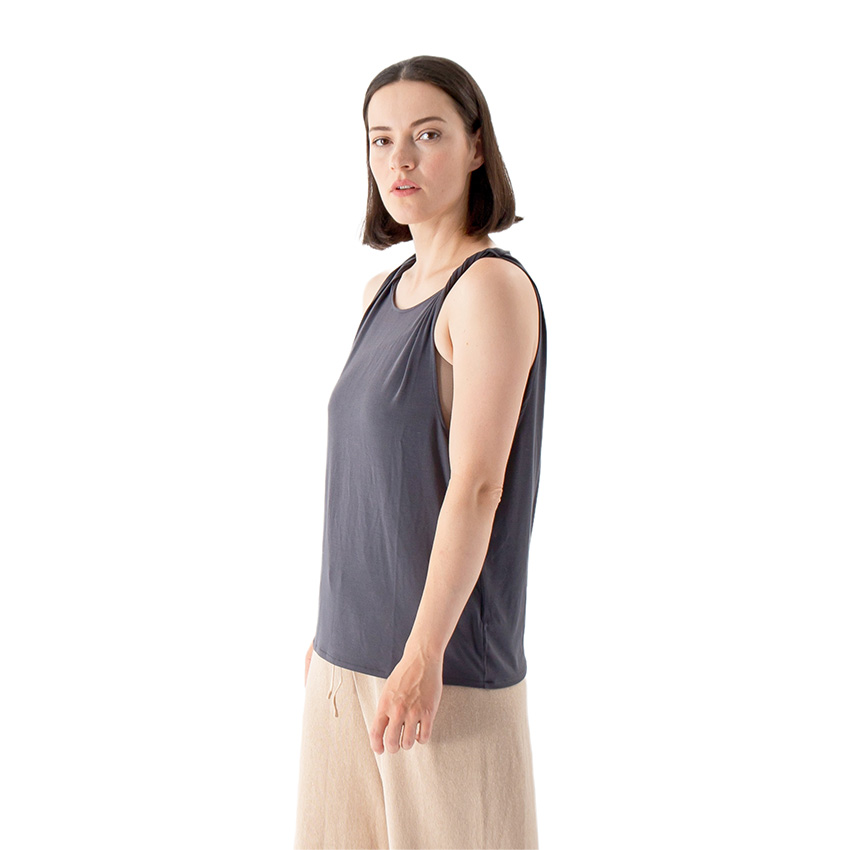
2. Finding the "Sweet Spot": Optimal Hemp Blends for Singlets
Procurement teams often assume 100% pure hemp represents the ultimate sustainable choice. However, pure bast fibers present distinct commercial limitations. An unblended garment feels overly rugged initially. It lacks the fluid drape consumers expect from an everyday base layer. Furthermore, pure hemp features zero natural stretch. You cannot use it for activewear without synthetic intervention.
To achieve commercial viability, factories must blend the fiber. Blending stabilizes the fabric, enhances the hand-feel, and reduces overall yarn costs. You must target specific blend ratios depending on your target demographic.
Blend Ratio | Target Category | Performance Characteristics |
55% Hemp / 45% Organic Cotton | Streetwear & Casual Staples | Balances rugged durability with familiar softness. Highly breathable, excellent structure, and standard commercial drape. |
30-50% Hemp / Tencel (Lyocell) | Premium Womenswear | Delivers a silk-like drape and ultra-soft hand feel. Extremely lightweight and ideal for luxury loungewear. |
Hemp / rPET / Elastane | Activewear & Performance | Combines moisture management with essential 4-way stretch. Necessary for garments requiring high mobility. |
When selecting your optimal mix for a Hemp Singlet, you must exercise caution regarding factory processing methods. Educate your buying teams to strictly avoid suppliers offering "hemp viscose." This deceptive term indicates the factory used highly toxic chemical processing to artificially soften the material. The resulting fabric behaves like rayon, completely negating the structural and environmental benefits you intended to purchase. Always demand mechanical softening or bio-enzymatic processing from your supply partners.
3. Assessing Bulk Manufacturing Capabilities: What to Look for in a Factory
Producing hemp apparel at scale requires specialized factory infrastructure. You cannot simply hand a hemp tech pack to a traditional cotton factory and expect seamless execution. The intrinsic toughness of the fiber creates unique manufacturing challenges on the factory floor.
Standard cutting and sewing machinery degrades rapidly when processing bast fibers. To avoid costly production delays, you must audit your partner’s manufacturing capabilities rigorously. Look for these three critical competencies during factory vetting:
Handling Fiber Abrasion: Hemp's tough exterior quickly wears down standard steel needles. Factories must install titanium-coated needles to handle bulk runs. Furthermore, operators must reduce sewing machine RPM (revolutions per minute) by roughly 15%. High-speed friction causes standard threads to melt or snap against the dense fabric. Slowing the RPM ensures consistent stitch tension and prevents needle breakage.
Advanced Degumming Processes: Raw hemp fibers contain sticky pectins and gums. Factories must remove these before spinning the yarn. Traditional factories use harsh chemical retting, which pollutes local waterways. You must partner with manufacturers utilizing bio-enzymatic degumming. This advanced process uses natural enzymes to safely dissolve gums, resulting in a softer, environmentally compliant yarn.
Dye Penetration Control: The fiber absorbs dye differently than cotton or synthetics. It requires longer vat times and extremely precise temperature management. If a factory rushes the dyeing phase, large bulk runs will exhibit severe color patchiness. Assess their dyeing facilities beforehand. Ask for lab dips across multiple yards to verify even color distribution.
Failing to verify these technical capabilities often leads to disastrous bulk orders. A factory lacking titanium needles will experience constant downtime, pushing your delivery dates back by weeks.
4. Mitigating Risk: Quality Assurance & Tech Pack Development for Bulk Orders
Quality assurance determines the success or failure of sustainable apparel scaling. When drafting a tech pack for a Hemp Singlet, you must proactively engineer solutions for the material's specific behavioral traits. Shrinkage control represents the single biggest risk.
Unlike synthetics, hemp exhibits unique shrinkage properties during its first wash. If your factory fails to account for this, your graded sizing will collapse in the hands of the consumer. You must mandate a strict pre-shrinking process, known as sanforizing, directly within your factory agreement. Do not leave this to verbal assumptions.
Your tech pack must leave zero room for factory interpretation. Essential inclusions consist of:
Exact Bill of Materials (BOM): Clearly specify the yarn count and GSM (grams per square meter). A lightweight summer top usually requires a GSM between 130 and 160.
Stitch Requirements: Specify flatlock or cover-stitch techniques for all seams. Hemp threads feel thicker, and bulky internal seams cause severe skin irritation.
Shrinkage Tolerances: Explicitly state acceptable shrinkage percentages (usually +/- 3%) post-sanforization.
Developing a flawless tech pack only solves half the equation. You must implement military-grade AQL 2.5 quality assurance standards across the entire production timeline. Do not wait until the garments leave the factory to inspect them. Break your QA protocols into three distinct phases.
Inspection Phase | Execution Timing | Critical Checkpoints |
Pre-Production Inspection (PPI) | Before fabric cutting begins. | Checking fabric rolls for consistent GSM, dye patchiness, and confirming bio-enzymatic degumming documentation. |
During Production (DUPRO) | At the 20% completion mark. | Verifying stitch tension, confirming the use of titanium needles, and catching early sizing deviations on the line. |
Final Random Inspection (FRI) | Prior to global distribution and shipping. | Executing AQL 2.5 random sampling to verify final sizing specs, label accuracy, and packaging integrity. |
5. The Economics of Scaling: Sourcing, Margins, and Shortlisting Partners
Many procurement teams hesitate when reviewing the initial quotes for bulk hemp fabric. You must understand the price reality immediately: high-quality bast fibers cost more upfront than conventional cotton. However, assessing this purely on unit cost ignores the broader retail strategy. You must reframe this expenditure as an investment in a five-year garment versus a six-month garment.
Consumers willingly pay a premium for authenticated sustainable basics. The inherent durability and eco-friendly narrative support higher retail pricing strategies. Your overall profit margin often expands despite the higher initial cost of goods sold. The key lies in strategic factory selection to manage scaling costs.
Evaluating Minimum Order Quantities (MOQs) requires a balanced approach. Brands often seek factories offering low MOQs for initial market testing. While helpful for minimizing risk, low-MOQ boutique factories rarely possess the vertical integration necessary for cost-effective scaling. You must identify dual-capability manufacturers. These partners facilitate small initial runs but own the larger hubs required to drive unit costs down once a product validates.
When shortlisting global partners for your Hemp Singlet production, employ a rigorous checklist. Verify direct-to-factory access to eliminate costly middlemen. Check their compliance credentials thoroughly. Demand current ISO and GOTS (Global Organic Textile Standard) certifications. Finally, address the legal compliance of the raw material. Confirm the supplier uses industrial hemp containing legal THC limits (strictly below 0.3%). This ensures the finished textiles face zero friction during global customs import procedures.
Conclusion
The hemp singlet represents a structurally sound and highly profitable entry point into sustainable bulk manufacturing. By transitioning away from conventional cotton, brands secure a massive advantage regarding incoming circular economy regulations, supply chain stability, and overall garment performance. The natural thermoregulation and unmatched durability justify premium positioning in any modern apparel catalog.
Moving forward, procurement teams should take immediate action. First, audit your current basics tech packs to identify viable replacement targets. Second, contact specialized dual-capability manufacturers and request swatch samples of 55/45 hemp-cotton blends. Finally, establish strict bio-enzymatic degumming and sanforizing requirements before signing any bulk purchase agreements. Mastering these production realities guarantees a seamless and highly lucrative scaling process.
FAQ
Q: What is the difference between wholesale and bulk orders for hemp singlets?
A: Wholesale refers to purchasing ready-to-sell, pre-branded inventory with low Minimum Order Quantities (MOQs), ideal for immediate retail distribution. Bulk orders involve custom, private-label manufacturing at scale. Bulk requires detailed tech packs, factory direct relationships, and longer lead times, but yields significantly better unit economics.
Q: Will 100% hemp singlets shrink after the first wash?
A: Yes, pure hemp garments suffer from high shrinkage rates if processed incorrectly. This is why strict factory pre-shrinking (sanforizing) is mandatory. We also highly recommend utilizing 55/45 blends to stabilize the fabric structure and minimize post-purchase sizing issues.
Q: Are there any legal or customs issues when importing bulk hemp clothing?
A: No. The industrial hemp used for textile manufacturing complies with global agricultural laws. It contains less than 0.3% THC and possesses zero psychoactive properties. As long as your factory provides proper documentation, your apparel will clear international customs like any standard textile.
Q: Can hemp singlets be used for high-intensity athletic wear?
A: While highly breathable and naturally antimicrobial, pure hemp lacks inherent stretch. For high-intensity activewear, you must use a performance blend incorporating elastane or recycled polyester (rPET) to provide the necessary 4-way stretch and mobility.


